
LBW explained
What LBW means
A batter can be out leg before wicket when the ball hits their pad or body instead of the bat, and would have gone on to hit the stumps. But LBW is more than the ball hitting the pad: the umpire works through three checks, in order, and every one has to go the bowler's way.
First, check the bat
If the ball touches the bat (or a glove holding it) before it hits the pad, or at the same moment, it can't be LBW. Listen as it passes: an edge is a sharp tick.
And check the front foot: a no-ball can't be out LBW, whatever happens next.
The three checks
- Where did it pitch? A ball that pitches outside the line of leg stump can't be LBW. Pitching in line with the stumps, or outside off stump, is fine. A full toss doesn't pitch, so it skips this check.
- Where did it hit? If the batter played a shot, the ball must hit them in line with the stumps. If they played no shot, a hit outside off stump can still be out. A hit outside leg stump never is.
- Was it going on to hit the stumps? Follow the ball on past the pad. It has to be going on to hit the wicket: passing over the bails or past either side is not out.
"Outside" means the whole ball is outside the line of the stumps. If any part of it is in line, it's in line.
Examples
- Pitched outside leg, would have hit: not out. The first check fails, so nothing else matters.
- Pitched outside off, hit in line, hitting the stumps: out. All three checks go the bowler's way.
- Hit outside off while playing a shot: not out. With no shot played, the same ball could be out.
- Hit in line, but the ball touched the bat first: not out. Bat first, always.
- Everything in line, but bouncing over the stumps: not out. It's missing.
How Stumpire shows you
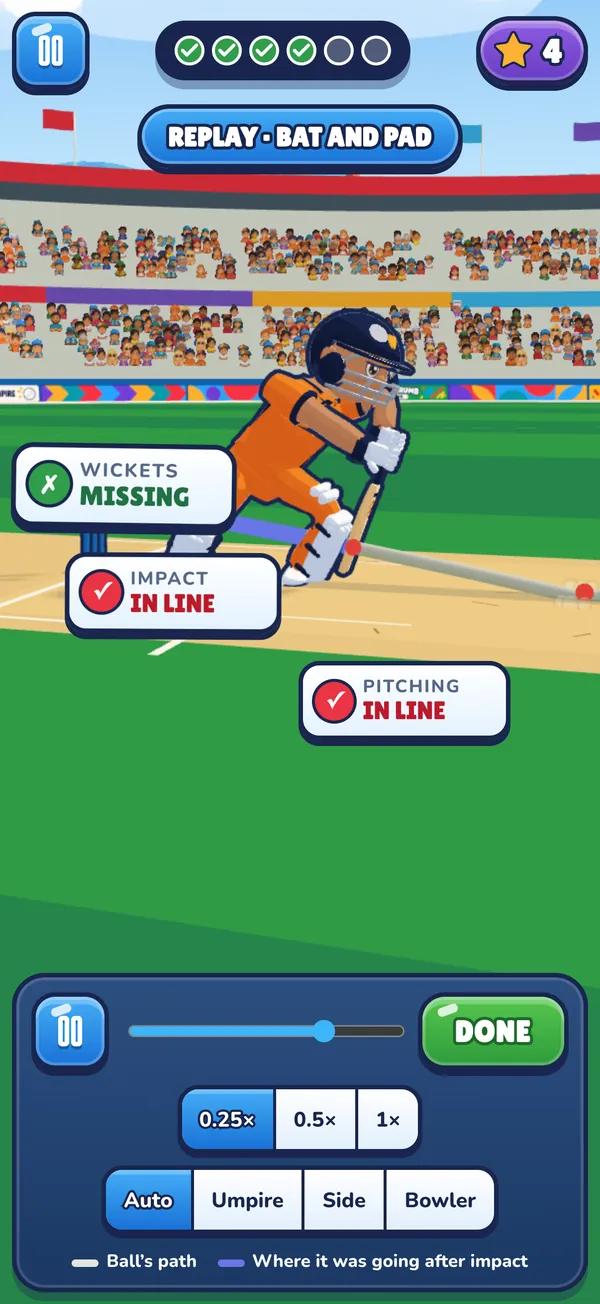
In Stumpire you make the LBW call in a few seconds, as an umpire does. Then the replay shows the evidence: ball tracking down to the stumps, with each check marked: pitching and impact (in line or outside) and wickets (hitting or missing), and an edge detector for a nick. Slow it down to a quarter speed and watch from the umpire's spot or side-on.
The LBW lesson, the first thing every player plays, has three appeals with the key moment in slow motion and no timer.
The Law
LBW is Law 36 of the Laws of Cricket, which the MCC writes. This guide puts it simply; the Law itself has more detail. Read MCC Law 36 (LBW).